Best Knee Braces for Pickleball
Compression sleeves, patella straps, and hinged braces — what each one actually does for a pickleball knee.
Affiliate disclosure: As an Amazon Associate I earn from qualifying purchases. This does not affect our recommendations or rankings.
Medical disclaimer: Consult with a doctor before beginning any exercise program or using any product described on this page. This information is for educational purposes and is not a substitute for professional medical diagnosis or treatment.
Knee pain is one of the most common complaints in pickleball, and the brace aisle is confusing — sleeves, straps, and hinged braces all claim to help, but they do very different jobs. A compression sleeve adds warmth and light support. A patella strap targets the tendon below the kneecap. A hinged brace is for instability after a real injury. Picking the wrong one doesn't just waste money — it can give you false confidence on the court. This guide breaks down the three types, when each works, and the specific products players and clinicians tend to choose.
McDavid Knee Compression Sleeve
4-way stretch sleeve designed to provide compression and warmth during activity
Why consider it — Sizing up is frequently recommended when between sizes, since a sleeve that's too tight may restrict circulation. Consult the manufacturer's size chart.
Skip if you need rigid support after a real injury — this is compression, not a structural brace.
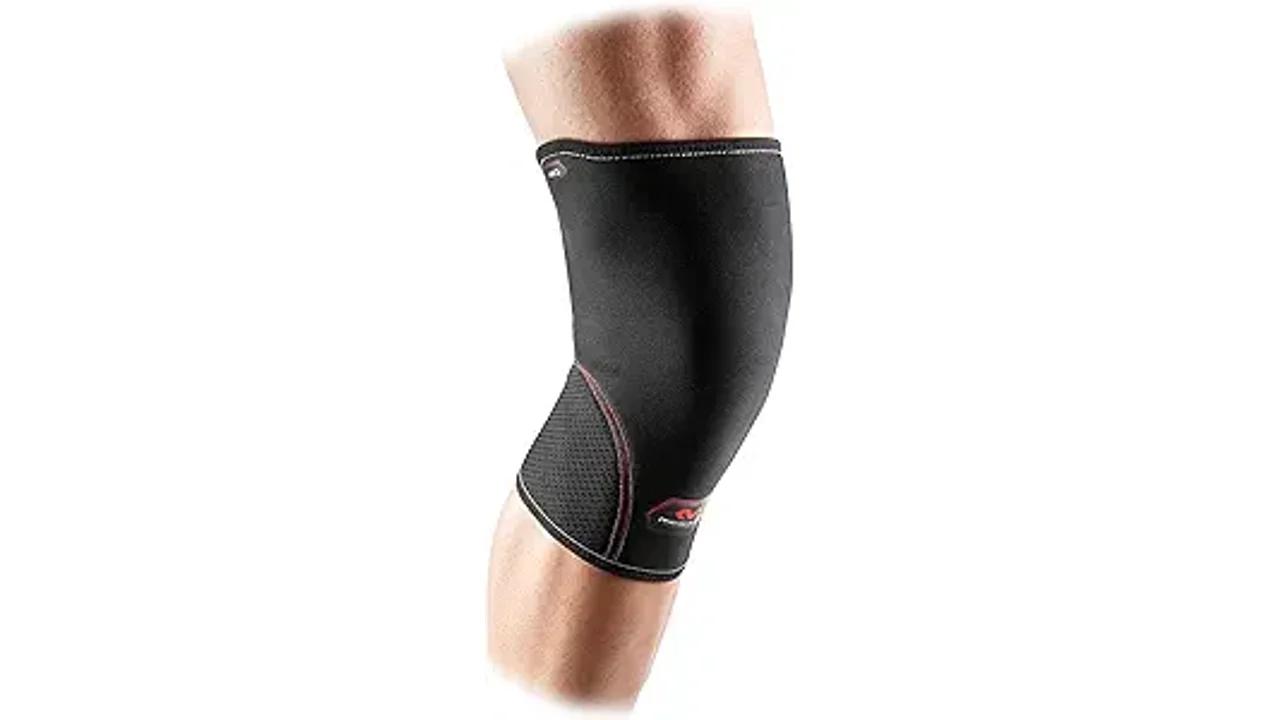
McDavid Knee Compression Sleeve
4-way stretch sleeve designed to provide compression and warmth during activity
Does not do — cure the injury on its own. It supports recovery alongside rest, exercises, and medical care when those are needed.
Why consider itSizing up is frequently recommended when between sizes, since a sleeve that's too tight may restrict circulation. Consult the manufacturer's size chart.
Skip if you need rigid support after a real injury — this is compression, not a structural brace.
Why this product — our top fit for this injury by our scoring. The clinical evidence supports this product's category — this exact model has not been independently tested.
Paid link · We may earn a commission from qualifying purchases.
Picked by our scoring (evidence 40%, condition fit 30%, user reports 20%, durability 10%) — not by commission. How we choose →
The three kinds of knee support
Before picking a product, understand what the three categories actually do. They're not interchangeable.
Compression sleeve
A pull-on sleeve covering the knee, usually knit elastic. Mechanism: warmth, mild compression, and proprioception — your brain gets better feedback about where the knee is, which helps with control. Does not mechanically stabilize the joint. Useful for general knee soreness, mild patellofemoral pain, and cold-weather play. The most common first pick, and the right one for most players.
Patella strap
A narrow band worn just below the kneecap, with a pressure pad over the patellar tendon. Mechanism: the strap changes how force moves through the tendon, reducing the load on the irritated spot. Useful when the pain is clearly at the tendon below the kneecap — patellar tendinopathy, or jumper's knee. The Cho-Pat Dual Action is the long-standing benchmark in this category.
Hinged brace
A rigid brace with metal hinges on both sides of the knee. Mechanism: physically limits the knee's range of motion and resists sideways movement. Useful for instability after a ligament injury or meniscus issue — when the knee feels like it might give way. Overkill for simple soreness, and too bulky for most players to wear comfortably through a full session.
Which one do you actually need?
A rough decision framework:
• General soreness or mild patellofemoral pain — compression sleeve. Warmth and light support, worn during play.
• Pain clearly at the tendon below the kneecap, worse with jumping or lunging — patella strap. The pressure pad targets the tendon directly.
• Knee feels unstable, gives way, or you've had a ligament or meniscus injury — hinged brace, and talk to your clinician about whether it's the right level of support.
• Pain that doesn't improve after 6–8 weeks of proper rehab — see a clinician. A brace manages symptoms; it doesn't fix weak hips or poor patellar tracking, which are the most common root causes.
Top product picks
These are the products pickleball players and clinicians most often recommend. All have strong track records and are readily available. Listed by category.
McDavid Knee Compression Sleeve
4-way stretch sleeve designed to provide compression and warmth during activity
Does not do — cure the injury on its own. It supports recovery alongside rest, exercises, and medical care when those are needed.
Why consider itSizing up is frequently recommended when between sizes, since a sleeve that's too tight may restrict circulation. Consult the manufacturer's size chart.
Skip if you need rigid support after a real injury — this is compression, not a structural brace.
Why this product — our top fit for this injury by our scoring. The clinical evidence supports this product's category — this exact model has not been independently tested.
Paid link · We may earn a commission from qualifying purchases.
Cho-Pat Dual Action Knee Strap
Dual-strap patella strap that applies pressure above and below the kneecap
Does not do — cure the injury on its own. It supports recovery alongside rest, exercises, and medical care when those are needed.
Why consider itMeasure your knee circumference before ordering — sizing runs generous, and a loose strap lets the pressure pad migrate off the tendon. If you're between sizes, size down.
Skip if you need rigid, ligament-level support — this is a tendon strap, not a structural brace.
Why this product — our top fit for this injury by our scoring. The clinical evidence supports this product's category — this exact model has not been independently tested.
Paid link · We may earn a commission from qualifying purchases.
DonJoy Performance Bionic FullStop Knee Brace
Hinged knee brace built for ligament-level support and instability
Does not do — cure the injury on its own. It supports recovery alongside rest, exercises, and medical care when those are needed.
Why consider itA hinged brace built for ligament-level support — most useful for instability after a knee injury, worn during play. Note: this ASIN is for one size variant (Large), so measure your knee and pick your size on the product page.
Skip if your knee pain is mild tenderness without instability — a compression sleeve gives enough support for far less.
Why this product — our top fit for this injury by our scoring. The clinical evidence supports this product's category — this exact model has not been independently tested.
Paid link · We may earn a commission from qualifying purchases.
What a knee brace won't do
A brace is a tool, not a cure. It reduces symptoms and lets you keep playing while you rebuild strength, but it doesn't fix the root causes: weak hips and glutes, poor patellar tracking, or volume ramp. The exercises in our knee pain guide — glute bridges, clamshells, single-leg balance — are what actually offload the knee long-term.
A brace also won't protect a knee that's genuinely unstable. If your knee gives way, locks, or catches, that's a mechanical problem that needs a clinician, not a product. See our knee pain guide for the full protocol and the red flags.
Sleeve, strap, or hinged brace?
Same knee, different support. The sleeve adds warmth and compression, the strap targets the patellar tendon, and the hinged brace is for instability after a real injury.
| Product | Best for | Watch out for |
|---|---|---|
| McDavidMcDavid Knee Compression Sleeve | 4-way stretch sleeve designed to provide compression and warmth during activity | Skip if you need rigid support after a real injury — this is compression, not a structural brace. |
| Cho-PatCho-Pat Dual Action Knee Strap | Dual-strap patella strap that applies pressure above and below the kneecap | Skip if you need rigid, ligament-level support — this is a tendon strap, not a structural brace. |
| DonJoy PerformanceDonJoy Performance Bionic FullStop Knee Brace | Hinged knee brace built for ligament-level support and instability | Skip if your knee pain is mild tenderness without instability — a compression sleeve gives enough support for far less. |
As an Amazon Associate I earn from qualifying purchases. Prices change — check the product page for the current price.
Frequently Asked Questions
Can I wear a knee brace all the time?
A compression sleeve can be worn during any activity if you find it comfortable. A patella strap is best worn during play and activity, not all day. A hinged brace should be worn as your clinician directs. None of them should replace the strengthening work — long-term bracing without addressing weak hips tends to produce dependence.
Sleeve or strap — which is better for runner's knee?
For patellofemoral pain (runner's knee), a compression sleeve is usually the better first pick — it adds warmth and proprioception, which helps with the tracking issue. A patella strap targets the tendon below the kneecap, so it's the better pick when the pain is clearly at the tendon itself (patellar tendinopathy). If you're not sure which one you have, start with the sleeve.
Do I need a hinged brace?
Only if your knee feels unstable or you've had a ligament or meniscus injury. A hinged brace physically limits the knee's motion — that's what you want after a real injury, and overkill for simple soreness. If your knee gives way or locks, talk to a clinician before choosing a brace.
How tight should a knee sleeve be?
Snug enough to stay in place and feel supportive, but not so tight that it restricts circulation or leaves deep marks. You should be able to slide a finger under the top edge. If your foot starts to tingle or your calf swells, it's too tight. When in doubt, size up.
Will a brace weaken my knee over time?
A brace worn during play won't weaken the knee on its own — but relying on a brace instead of doing the strengthening work will. The brace manages symptoms; glute and quad strength is what actually protects the knee long-term. Use the brace while you build the strength, then reassess.
Related Injury Guides
Keep Reading
Is Pickleball Bad for Your Knees?
Pickleball knee pain is real — but is the sport bad for your knees? Honest evidence review of the risks, who's affected, and how to protect your joints.
The 5-Minute Pickleball Warm-Up
The 5-minute pickleball warm-up routine that prevents tennis elbow, calf strains, and Achilles issues. Do this before every match.
Build Your Personalized Kit
Put what you just read into action. Our selector cross-references your specific pain points against every product in our database.